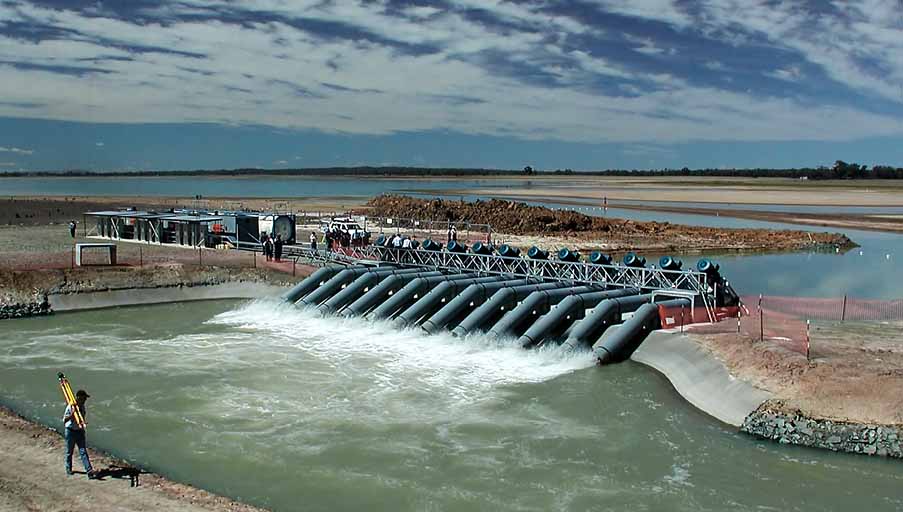
Axial flow is the family that built the company. Single-stage, high-volume, low- to medium-head — the right choice for irrigation channels, drainage, river diversion and large stormwater pumping. Simpler castings than mixed-flow turbines, lower initial cost, and an open parts file for every unit we have shipped since 1951.
The range covers nineteen sizes. Capacity overlaps deliberately, so several models can hit the same duty point — selection is driven by NPSH, sump geometry, available power and the customer’s preference for impeller speed. Designations like 14/16 read directly: a fourteen-inch impeller in a sixteen-inch column.
Beyond clean-water irrigation, the same pumps serve flood mitigation, municipal water supply, marine bow-thrusters and aquaculture. Our portable Portax pump is a member of this family, scaled to a frame and a small prime mover.
The traditional sump-mounted pump. Most common for irrigation channel installations and works with prime mover above the slab.
Inclined 36° from horizontal on a slide rail anchored to the bank. Least obstruction to river flow, least bank disturbance, least infrastructure.
A short-set arrangement that drops the drive column entirely. Lowest first cost — used in wells, prefabricated structures and tight installations.
The traditional vertical pump is most often used for pumping from sumps of one type or another. Cost is less than for an equivalent angle application pump. Vertical pumps will also serve open water sources — rivers, dams, channels — with appropriate supporting structure, although an angle pump is usually more economical for those.
Where the depth of a sump exceeds six metres, excavation costs become excessive. In that case the alternative angle application pump should be considered — it can frequently provide a more cost-effective system layout.
The mounting plate is normally bolted immediately below the discharge head flange, and allows the pump to be rotated in one-hole increments for discharge alignment. For below-ground discharge the mounting plate may be located at any of four alternate positions. A sump cap and swivel-mount is available where pumping is required from elevated water sources — the fabricated steel cap is machined to take a rubber sealing ring, hot dip galvanised, and the design permits pump removal without cap detachment.
Extended Drive Column.
Places drive head above flood level, or discharge below ground. Please indicate preferred location of mounting plate (above or below the discharge head, or at flanges below the drive head), drilled to suit location.
Electric, solid shaft — direct coupled.
Suitable when pump RPM matches motor RPM. An electronic speed controller may be used to optimise impeller speed or adjust flow rate.
Electric, hollow shaft — direct coupled.
This type of motor is robust and compact. Pump spindle extends through the motor, impeller thrust is taken on motor bearings — eliminating the pump thrust bearing and the flexible coupling. Simplifies maintenance; motor is more expensive.
Electric, foot mounted — vee-belt drive.
Low cost. Basic but effective. Pulley change adjusts pump speed independently of motor speed.
Diesel, crossed vee-belt.
Low cost, suitable for up to six belts or 45 kW (60 hp) maximum. Change pulleys to alter flow rate while keeping engine RPM in optimum range.
Diesel, universal shaft — angle gear drive.
Avoids vee-belts. High efficiency, long running. The premium diesel arrangement for sustained duty cycles.
The angle application pump presents the least obstruction to river flow, causes the least bank disturbance and requires the least infrastructure of any open-water installation we offer. The pump axis tilts thirty-six degrees from horizontal — that inclination minimises the support structure on a riverbank or storage dam.
Pumps are mounted on slide rails anchored to the bank. The slide rail facilitates both installation and maintenance retrieval — the pump can be drawn up its rail without dismantling the discharge piping. Discharge outlets can be positioned above or below ground level.
An extended drive column option positions the power unit and thrust bearings well above potential flood levels — a standard specification on the working rivers of southern NSW and northern Victoria.
Diesel, universal shaft — angle gear drive.
Selected gear ratio optimises engine RPM independently of pump speed. The premium diesel arrangement — avoids vee-belts entirely. High efficiency, long running.
Diesel, universal shaft — direct coupled.
Used where pump RPM matches the engine’s operating range. Avoids vee-belts. High efficiency, long running.
Electric, foot mounted — universal shaft.
Suits matched pump/motor speeds, or installations using electronic speed control. Avoids vee-belts and allows independent mounting of large motors away from the pump itself.
Electric, flange mounted, solid shaft — direct coupled.
Suitable where RPM matches, or where electronic speed control is fitted. The simplest electric arrangement on an angle pump.
Electric, hollow shaft — direct coupled.
More robust and compact. Pump spindle extends through the motor shaft, eliminating the thrust bearing and flexible coupling and simplifying pump dismantling. Limited to special motors.
Electric, foot mounted — vee-belt drive.
Lowest-cost RPM-matching solution. Discharge rate is adjustable simply by changing pulleys.
Biodegradable oil drip-fed from above into an enclosed steel lube-tube on bronze bearings. Hot dip galvanised internally and externally to prevent corrosion contamination. Adjustable drip-feeders standard; solenoid option permits lubrication to commence fifteen minutes prior to starting in automated systems.
Stainless steel shaft running in EPDM rubber bearings. Packing gland or mechanical seal at the discharge head depending on pressure. Lineshaft bearing spacing within 1.22 m for AS2941 (Fixed Fire Pump Standard) compliance. Thrust bearing water-jacketed from pump discharge — air-cooled or thermosyphon alternatives available where discharge pressure is insufficient.
The extended drive column option raises thrust bearings and the drive unit above flood level, protecting critical components during high-water events. Thrust bearings must be kept above flood level — the column is built to put them there.
Cooling water is normally circulated from the pump discharge to a water-jacketed bearing housing at the top of the extended drive column. If discharge pressure proves insufficient, the alternatives are an air-cooled housing or a separate thermo-siphon cooling system.
For water-lubricated systems, sections are limited to 1.22 m maximum length due to bearing placement constraints; where internal pressure can’t reach upper bearings, an external flushing system or grease-lubricated roller bearings are fitted. Oil-lubricated systems use bronze bearings in an internal lube-tube and allow longer external column lengths — greater flexibility on tall installations.
Drive column sections may be ordered in any combination of standard lengths, ranging from 305 mm to 2438 mm depending on lubrication type.