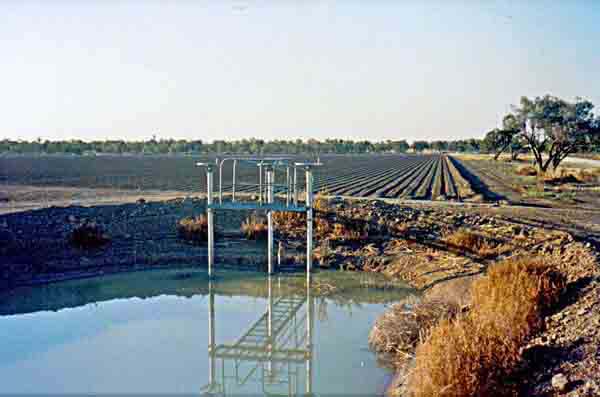
The High Head is our most popular model for penstock and channel-gate applications — used extensively in Australia and South-East Asia for everything from irrigation and drainage control to mining and marine duty. Suitable for operating heads to six metres (20 ft).
Five mounting models are made to suit different attachment methods. Sealing is effective against pressure from either direction. The removable top cross-frame allows vertical dismantling in-situ — the valve can be serviced without breaking the line. Standard fabrication is hot-dip galvanised 6 mm mild steel; stainless 304L or 316L can be specified.
Handwheels are fitted as standard, although power actuators of various types are also used — local and/or remote control on request. Technical Services will advise on actuator types in service.
Roller and cam-following action.
Rollers guide and control the valve door as it approaches a stainless steel seat. The cam-following action clamps the resilient seal tightly against the seat without dragging it across the surface. On opening, the same mechanism quickly separates a seal that has stuck after a long period of disuse, then allows rapid winding. A telescopic control column gives non-rising handwheel operation.
Ball-bearing supported control screw.
The control screw is supported in ball bearings — both rotational and thrust, in two directions — so it stays smooth under either on-seating or off-seating load.
Acme thread, jam-resistant.
A large-diameter, jam-resisting stainless steel Acme thread engages a large bronze nut. The thread profile is forgiving of grit ingress, the bronze nut is sacrificial and serviceable, and the assembly stays operable after long periods of inactivity.
Pressure rating — metres head
On-seating pressure is constant at 6 m across all sizes (300 mm through 1800 mm bore). Off-seating de-rates only at the three largest sizes — 5 m at 1500 and 1650, 4 m at 1800.
A flat steel door slides vertically within the side frames, inclined at a slight angle. The rubber sealing ring — riveted and glued into a recess in the body — sits at the same angle. The door and seal come together with a wedging action as the door is lowered.
Faster operating than screw-actuated valves thanks to a geared drive mechanism — convenient when several valves have to be operated in sequence. Lower mechanical advantage means a stuck valve will be harder to break free; a screw-jack at the top of the valve is provided to break a stubborn seal. A ratchet pawl locks the valve in any partly-open position. Gear teeth are precision-machined steel, the pinion shaft runs in ball bearings, and extension frames raise the handwheel to a working height in deep installations.
Standard sizes fit Class 2 concrete pipes from 600 mm to 1200 mm. Normal construction is hot-dip galvanised mild steel; stainless 304L or 316L on request.
The largest valves in the catalogue. Standard sealing is in both directions to eight metres head; modified versions go to twelve metres. Available bores: 1200, 1500, 1800, 2100, 2400 and 3000 mm — up to ten feet of clear opening.
These manage flow between water streams and storage facilities at the high end of the volume curve — rapid water capture during availability windows, emergency discharge, and standard irrigation distribution at scale. The smaller members of this family handle general irrigation duty.
A fully self-contained sealing system, somewhat more substantial than the traditional button valve. Designed primarily for sealing upriser pipes entering open channels — though the roller-guided door means it can be mounted in non-vertical positions when needed.
Roller guides eliminate door flutter, removing the fatigue-cracking risk that limits a less-supported door. The built-in stainless steel seat doesn’t require any pipe-surface preparation, and a dust-proof housing keeps the control mechanism above water level. The Acme thread on the control screw uses the same jam-resisting stainless / bronze pairing as the High Head range.
Square base flanges accommodate bolting to flat surfaces or concrete collars. Installation kits include gasket material, washers, anchor bolts and masonry drill bits.
Two configurations: fully enclosed in-line valves, and simple end-of-line flaps. Each available with flange, welded or grouted attachment to suit the line. All Batescrew non-return valves have stainless steel seats and rubber seals.
Standard construction is hot-dip galvanised mild steel; stainless 304L or 316L on request. Standard maximum operating head is eight metres; higher-head versions are made to order. The rubber compound is selected against the operating head — specify the head when ordering.
The seat is a stainless steel ring welded to a pipe spigot, inclined at five degrees from the vertical — gravity-assisted sealing that closes at zero pressure and keeps insects out of the line. A resilient disc clamped to the pivoting flap provides the seal.
Common applications: protecting pumping systems from reverse flow, controlling multiple drainage lines into a sump, and preventing backflow at drainage outfalls into waterways. We can advise on pressure-surge protection and head-loss calculations.
Stainless valves for wastewater applications and sewerage ponds. Normally supplied with handwheels for manual operation; power actuators are also available, with many optional features. Default construction is stainless 304L; 316L is specified for chloride-rich product or marine duty.
Power actuators may be set up for local and/or remote control. Our Technical Services Department advises on actuator types in service. Two main valve bodies are typically used here — the Square Throat for grouted-in installations, and the stainless High Head where the channel-gate format suits.
A diverter valve replaces a pair of gate valves in a line changeover — a single body, a flap that swings between two branch outlets. Sealing relies on the pressure differential between inlet and outlet; the door carries resilient rubber seals that contact stainless seats in the branch pipes.
Fabrication is from 6 mm material — mild steel hot-dip galvanised, or stainless 304L / 316L. Flanges or plain spigots for welding or grouting are available. Mixed inlet/outlet sizes can be specified, seal thickness and hardness are matched to the maximum operating head, and gear actuators improve door control on the larger sizes.
Important: do not change the flap position while a flow exists through the valve. The flap will catch in the flow and snap over rapidly — possibly causing injury and water-hammer. Pressure surges of up to ten times normal line pressure can occur and may rupture pipes. A pressure bypass line with stop valves is typically necessary before operating the valve.
Seven nominal inlet sizes are available, 300 mm through 1500 mm.
Power actuators.
Available across the range, set up for local and/or remote control. Many optional features — speed control, position feedback, fail-safe settings. Technical Services advises on actuator types in current service.
Extended control column.
For deep installations — raises the handwheel or actuator to working height above the valve body. Telescopic on the High Head range, allowing non-rising handwheel operation.
Optional accessories.
Position indicators, locking devices, gasket and anchor-bolt kits, masonry drill bits where the install requires them. Specified during the order to avoid second-trip site work.