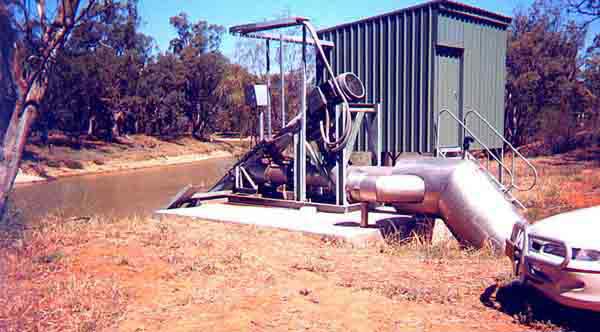
Where head climbs beyond the working envelope of axial flow, we move to mixed-flow turbine pumps. The impeller geometry combines centrifugal force with vane reaction — efficient pumping at medium and high heads, with the ability to stack stages for proportionally higher delivery pressure.
Capacity runs from five litres per second to sixteen-hundred, depending on size and stage count. Output can be tuned by changing rotational speed while staying within the efficient operating band — useful where pump duty must vary with seasonal demand.
Maximum stage count (and therefore maximum pressure) varies by pump model and is shown on the performance curve datasheets. Lineshaft bearing spacing stays at or below 1.22 metres for AS2941 (Fixed Fire Pump Standard) compliance — that means more bearings per pump than a competitor will typically fit, and a longer service life on the line shaft.
Vertical bore installation. Drive head sits above the slab, lineshaft drops down to the impeller assembly. The most common configuration for deep wells, basin draw-off, sump pumping and municipal supply.
Same mixed-flow wet-end on a slide rail anchored to the bank. Suits riverbanks and storage dams where minimising civil works matters more than absolute head.
Oil lubrication.
Bio-degradable vegetable oil drip-fed from above into an enclosed steel lube-tube on bronze bearings. Adjustable drip-feeders standard. Recommended whenever the pumped product carries grit or suspended solids — the enclosed tube keeps the lineshaft out of the abrasive stream and away from any risk of corrosion contamination.
Water lubrication.
Sand-free potable water lubricates a stainless steel shaft running in EPDM rubber bearings. The most economical configuration on shorter pumps. Packing gland or mechanical seal at the discharge head, depending on pressure.
Fresh-Water Flush — environmentally sealed.
A sealed system used where the pumped water cannot be allowed to contaminate the waterway, or where the pumped product itself is not bearing-friendly. Filtered discharge water — or an independent fresh-water reservoir if the discharge is unsuitable — is delivered to the bearings under low pressure and expelled into the product stream.
The turbine range shares its drive options, thrust-bearing adjustment and design-calculation service with the axial-flow family. Same six vertical drives, same six angle drives, with their pros and cons set out in detail on the axial-flow page.
In broad terms: extended column for flood-protected drive heads, solid shaft direct-coupled where RPM matches, hollow shaft where you want to eliminate the thrust bearing and flexible coupling, and vee-belt arrangements where pulley change is the cheapest way to alter pump speed independently of motor or engine speed. Universal shaft / angle gear diesel is the premium long-running specification.
For an extended drive column, sections are available in standard lengths from 305 mm to 2438 mm — water-lube limits to 1.52 m, oil allows the longer increments. The same documentation pack — sectional drawings, performance curves, service manuals, AS2417 test reports — applies to the entire turbine range.